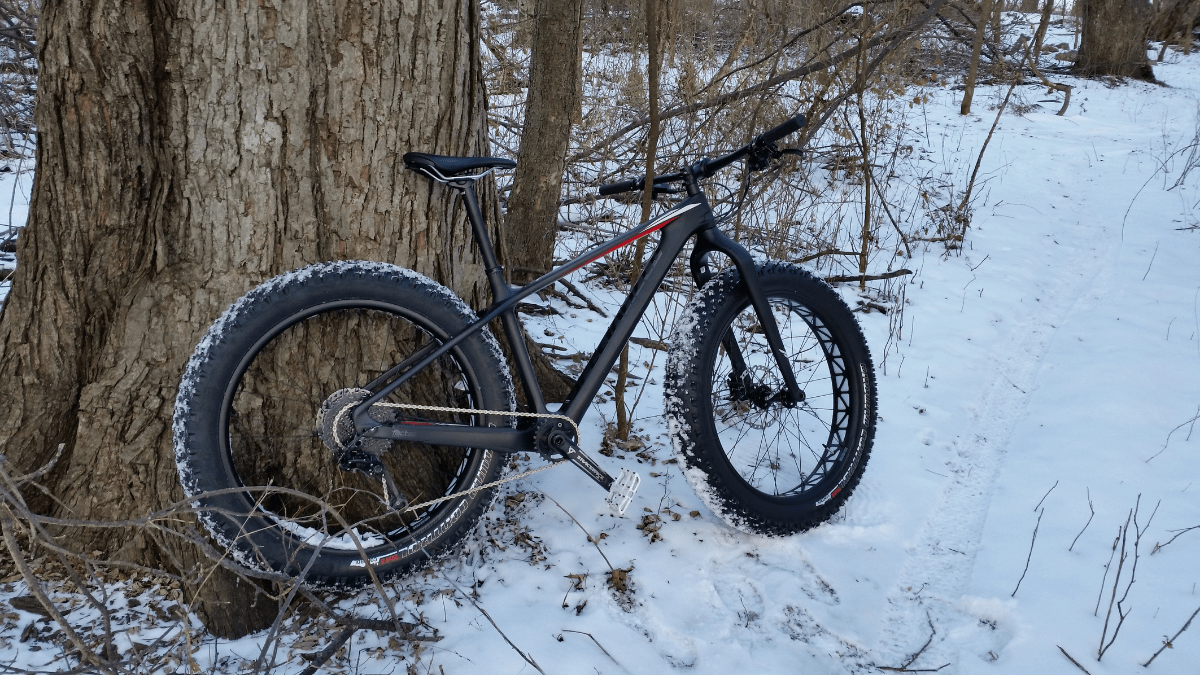
It’s November, it’s nearly winter, and I want to talk about fatbikes for a while. I got into fatbikes early in my riding history. I remember walking into the bike shop and being transfixed by the enormous tires and the possibility of never having to stop riding. They were a huge part of my early riding and kept me riding when I may not have stuck with the habit, otherwise. Also, nobody asked about this opinion, at all. That means it’s perfect to share on the internet.
It’s worth mentioning that I really started riding to get a sense of escape from some really dark times in my life, and though those are beyond the scope of the article, it’s useful to understand why I might’ve been pretty interested in the idea that you could ride year round on a rig and never have to stop. The good times, presumably, wouldn’t end.
I’m really not trying to rail against fatbikes. I’m mostly trying to explain why my interest fell off so hard. Besides that, it would be patently ridiculous to be against something as innocuous as a fatbike when there are much, much bigger fish to fry just… in general. Try thinking of a bigger fish in need of frying, I bet it’ll come to you instantly. This article really takes the form of documentation for my future self, reminding me why I decided these things weren’t for me. This is just in case the desire to slowly trundle around on wide tires would ever seize me again. It may help keep you from replicating my experience, as well, and that would be a net win for both of us!
The Beginning
My initial fatbike experience was positive, really. Cruising around in snow, where I live (the north central US) was reasonably fun, if slow. The slow part would eventually become quite a problem, but we’ll get to that later.
Indeed, the increased traction was definitely present and I found that I was able to make it through stuff that other bikes would experience handling issues in. Notice – I did not say other bikes wouldn’t make it through, only that they’d experience “issues.” How’s that for nebulous and poorly-defined?
The fatbike was the go-to bike for a few years. I’d consistently choose it for singletrack, all-season gravel, snow, mud, and at least one sandy/silty lake shore traversal. But some really important things came to the surface that ultimately saw me getting these bikes out of my life.
The Bike’s Capabilities
First and foremost I will admit, readily, that the fatbike offers so much more traction than a mountain bike, or any other kind of bike, really. That isn’t up for debate and to pretend otherwise would be silly.
But what does that traction actually get you? You might feel more stable and “planted.” I certainly described it as “feeling Velcroed to the ground.” That feeling was comforting, for a while.
Additionally, all that tire helped me navigate things that other bikes would have troubles with, like tilled up fields (we sure have plenty of that available for several months of the year), stones, big roots, etc…
But the capabilities of the bike were drastically oversold. Not by the bike shop, necessarily, so I’m not throwing them under the bus here. But by the general feeling around fatbikes in general.
“You can ride through snow!” Well, no. You can ride through some snow. In fact, there is a very narrow band of conditions where a fatbike is able to get through something that a different bike couldn’t. If you have something far enough up the front wheel to hang it up or impede it, you’re really not getting anywhere. If it’s over the level of the hub, forget about it.
It’s worth mentioning that “snow” is never just “snow” either. It can be powdery and dry, or heavy and wet. It can be finely crusted on top with powder underneath. It can be warm enough that it’s almost rotten in consistency, appearing solid enough to ride but causing you to sink deeply and frustratingly when you put some weight on it. This is by no means an exhaustive list, either!
Anyway, it got bad enough that I once joked that fatbikes and wintertime riding are for people who wanted to develop a firm understanding of the meaning of “get off and push.”
The reason that I felt this way is because even though the additional traction and “float” help you navigate snow, it really doesn’t do much for all the myriad kinds of snow that one might encounter. You tend to have to have a groomed trail, in some fashion or another. A fatbike enthusiasm meant that I owned a pair of snowshoes and used them to begin stamping out trail on the property where I rode. I believe that I spent more time maintaining my own trail than I did actually riding my bike on it, which is not an enviable situation. After all, I didn’t buy a bike only to use snowshoes instead.
This is especially a problem where I live, specifically. Snow is often accompanied, or followed by, wind. Very strong, insistent wind that creates ground blizzard conditions. This often meant that an entire session of trail stomping would be undone quickly as the topography changed in a hurry. Rolling that boulder up the hill, voluntarily, only worked for so long before I decided maybe it was time to hang the snowshoes up and find something else to do.
Rider’s Capabilities
The biggest drop off for all-season fatbike use, for me, was the fact that I simply got more fit. Over a few years, I managed to develop enough of my riding abilities that I felt that what used to be advantageous was either unnecessary or, in the worst cases, holding me back.
Since I started early in my riding “career,” I was absolutely not very fast. This meant that I was able to ride the fatbike at about the same speed as any bike I was on, more or less. That was also the time when I was exploring all the kinds of bikes and riding available, and wasn’t yet into the “Fewer Bikes, More Miles” mindset, so I had options available. Usually, I’d choose the fatbike – it just seemed fun.
Eventually I was in better shape. It’s great when that happens! It also meant that I was able to go quite a bit faster on other bikes. This isn’t to say that you can’t ride a fatbike fast, of course. But for the same input, something like a gravel bike or a road bike will definitely go faster. I realized quickly that I was into that. This made the fatbike slowly fade as the bike I picked up first.
I also developed my handling skills over time and discovered that I didn’t have to lean on the “planted” feeling that the tremendous tires gave me. I also found that I wanted something that wasn’t so determined to stand up straight.
Further, working on developing better fitness meant that I was much more concerned with time on the trainer over the winter instead of time trundling around on a fatbike. If I wasn’t on the trainer, I was doing some other variety of activity with the intention of becoming more generally fit for my riding excursions.
I also eventually added the term “Q-Factor” to my lexicon, and discovered that I had opinions about it. Fatbikes never made me super uncomfortable, but they certainly had their comfort overshadowed by other bikes that had a narrower bottom bracket area.
Mechanical Understanding
One of the biggest things that changed was understanding my equipment better, or making key upgrades, in some cases.
When I got a mountain bike set up with tubeless tires and began to understand how much traction I could get out of a tire set up intelligently, it occurred to me that I didn’t need all that much tire. I could have all the traction I needed but also have the advantages conferred by more nimble wheels.
As my handling skills increased, I also discovered just how much I liked suspension. Not really for the comfort benefits, though those are definitely nice, but for the traction benefits that it also offered. I know full suspension fatbikes are a thing, but they were always out of my price range and, as far as I know, becoming somewhat scarce these days. Regardless, I really liked the feeling of my wheel tracking properly over various kinds of terrain, without the wild springiness of a partially deflated tire. Strange how something predictable makes you feel more in control of the bike, no?
Preferences
I could have overlooked all of the above and kept on with the wide tire lifestyle. In fact, I was pretty sure that was going to be the case for me. Even if I was faster on other bikes, I’d still want to hit some terrain that the fatbike would really excel in, no?
Well, no. It turns out that wasn’t the case.
During the non-winter months, there is no shortage of options available for riding, but this means that there will ultimately be a hierarchy of preferences per rider. My preferences lean strongly towards terrain that was navigable by fatbikes’ slimmer cousins. This meant that sand, mud, really loose gravel, chunky ground, etc… was right out of the question.
In winter, I simply choose not to ride if I can’t get around on one of those aforementioned slimmer bikes. Most often, I’m choosing not to be outside on a bike at all. Partially because of what I covered earlier, but also because riding in the winter is a pain in the neck. It’s true that staying warm isn’t a big trick when riding in the winter (it’s tougher to manage to stay cool and dry), but it does mean that I had all this extra cycling kit laying around that was absolutely useless for the rest of the year. I owned gear dedicated to going slowly in the cold. I even had to own lights to mount to the bike so I could see where I was going, because night starts right around 5:00 PM, as does riding time.
Midway through one winter, between late 2017 and early 2018, I finally had to admit to myself that I just didn’t like this very much.
So… you hate fatbikes
Nah. That’s really not the point of this. The point is to talk about a trend that I saw firsthand and actively participated in with the benefit of hindsight. There are people who live in areas where year round riding makes perfect sense. Maybe they have the support for wintertime trails and fatbike events. Maybe they just have more patience than I do for (subjectively) suboptimal conditions.
The point of this is to be honest with yourself about the kind of riding you want to do. Once the novelty of a fatbike had worn off for me, I persisted in forcing myself out the door to get on it. Somehow, despite all of my experience to the contrary, I still thought they were capable of incredible feats of snow traversal. I really, truly wanted to believe this.
Further, I thought I was capable of that stuff. I suppose I am, but I don’t really care to be. I’d rather select something else to do with my time.
Ultimately, fatbikes have their niche. If that niche works for you, then these are the ideal rigs. If not, I suspect you’ll find them an expensive, unsatisfying experience.
They do look cool, though.
 Gradually Faster
The do look cool and I’m sure they have their purpose as you’ve said. Not much use for them out here unless you fancy riding up and down the sandy beach I guess!
LikeLike
I would take a sandy beach over hardcore snow any time! Unfortunately, I’ve got an excess of one and not much of the other.
LikeLiked by 1 person
I’d definitely like to try a fatbike over snow, I think it could make for a really nice ride if you’ve got the right trail. What’s really interesting are eMTBs built up as fatbikes. I rented one this summer and was riding up and down the Austrian alps. With the gearing, suspension, battery boost and wide tyres, it went places I could never go on a normal MTB. Riding on the flats was sucky though.
LikeLike
I definitely agree that they make nice rides on the right trail. That said, I gave them a try over just about every terrain I could think of from 2012-2019 and noticed that I really didn’t miss the experience when I took the year off. Ultimately, it was completely subjective – they excel in terrain I didn’t really want to find myself navigating in the first place.
I’ll find other stuff to do in the winter. Ideally, hibernation. That seems like a fine plan.
LikeLike