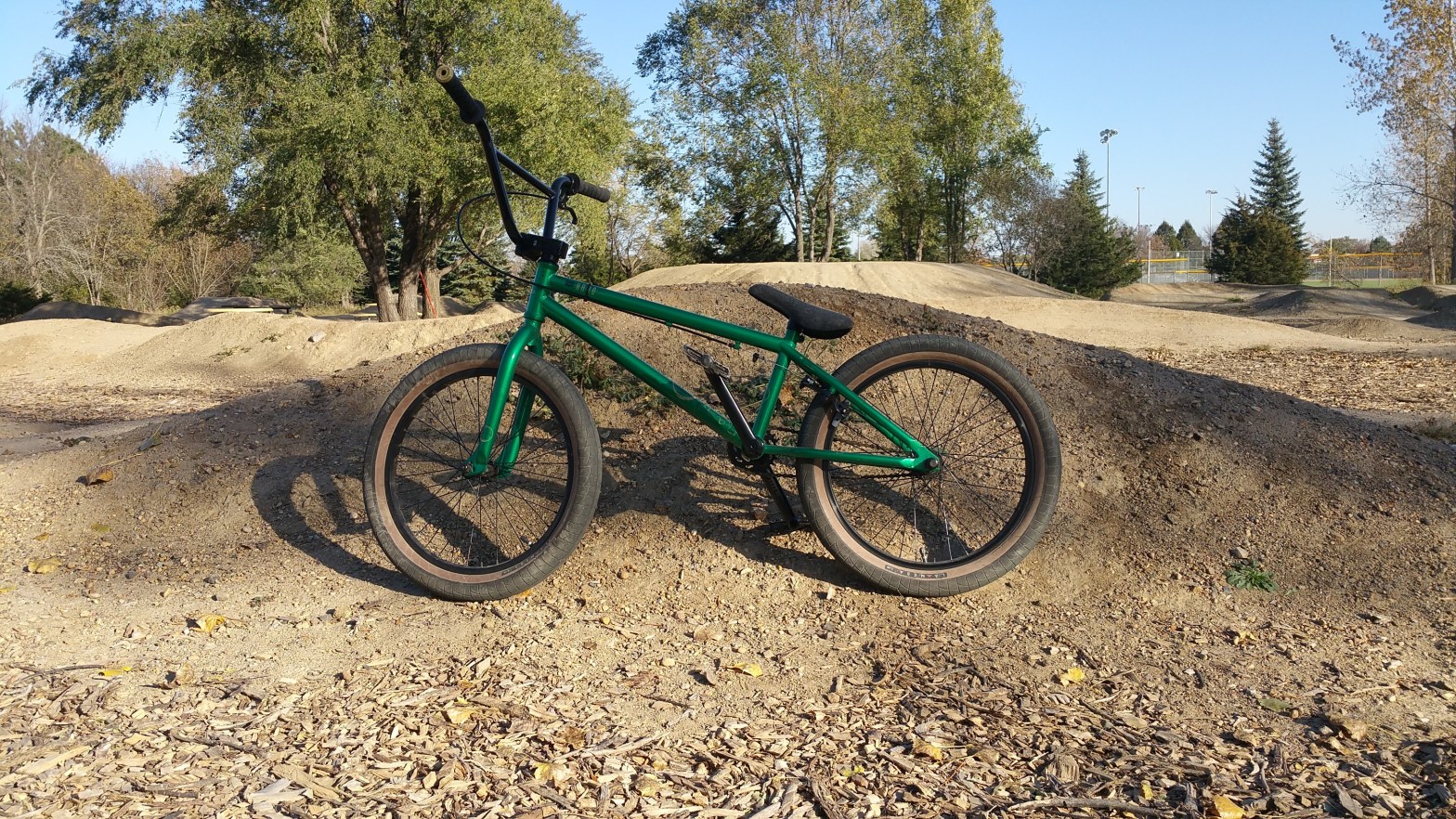
If you’ve never ridden a pump track, and you are any sort of mountain biking enthusiast, you have to give it a shot. They are great at making you gradually faster because they teach you useful things about cornering, momentum, and free speed off anything that resembles a roller. But those benefits deserve their own article. To get those benefits, you need to have access to a pump track. Of course, to have access to one, one must exist. The case for having one exist in your city is very compelling.
What is a Pump Track, Anyway?
A pump track is a loop of humps called “rollers” and bermed turns that is designed to be ridden by “pumping” up and down in time with the natural motion of going over a roller. This pumping action allows one to maintain or gain speed without having to pedal (or equivalent, in case you’re not on a bike). The rollers and berms are specially designed to facilitate this purpose.
They’re Cheap
Relatively speaking. There are generally two options for material and one carries greater upfront expense than the other.
Dirt
“Dirt cheap” is a common idiom for a reason and a perfectly usable pump track can be made out of dirt. It doesn’t even really need to be amazing dirt, necessarily. It just needs to be some dirt you can compact neatly into features. You’re also able to add features or change existing ones reasonably easily with some sweat and labor.
Dirt does require regular maintenance, though, and has some stipulations regarding drainage so that the track doesn’t have water issues. Those aren’t insurmountable and a team of volunteers with some simple tools can handle the bulk of the maintenance after initial construction. Without regular maintenance a dirt track can fall into serious disrepair and eventually become unusable.
Dirt also limits the kind of trail user to essentially only people with suitable wheels for riding dirt. It’s also limited by conditions in that dirt tracks have to be dry before riding, otherwise they get very damaged, very quickly.
Paved
They also can be paved with asphalt or concrete. Paved pump tracks can be enjoyed by a wider variety of users because they’re not functionally limited to bikes. They also don’t have quite the same maintenance overhead that dirt does, so they will not require a team of volunteers to constantly look after the track surface.
However, a paved track costs more to construct and isn’t something that can necessarily be done by a few motivated people with shovels. Design considerations are more important because the track will be essentially permanent – it would be no small task to break down and rebuild a feature. You also can’t add a feature quite as easily, given that you’d have to start anew with the design and construction process for any additions that you’d care to make.
Who Can Use One
Pump tracks are suitable for users of all skill levels and ages. The difficulty of a well-designed pump track is, to a large degree, determined by user input.
More advanced users will be able to get value out of a track as they improve speed and handling and discover new lines to take around the track. Rollers can be jumped. Berms can be taken more aggressively.
New users will be able to enjoy a much more mellow track experience. In addition, they will be able to measure skill progression over time as they work their way into a more advanced class of track user.
Given the multiple available lines, and potentially the size of the track, the spectrum of users from beginner to advanced can peacefully coexist on the same track. After all, you can’t be everywhere on the track all at the same time. This also means that these tracks are suitable for families in addition to individual users.
A prospective user interested in using a bike does not require anything specific in terms of bike. As long as they are confident of their bike’s ability to handle the terrain (that is, if it’s dirt they have good tires for traction) they will be able to get some use out of the track. This further widens the potential user base. Personally, I have seen someone use a commuter-style bicycle on a track without so much as a hint of a problem.
Size
A pump track doesn’t need to be enormous to be fun. In fact, clever design can result in tracks that use almost any available space. A quick Google image search for “backyard pump track” will reveal small tracks that offer large rewards. There can also be individual tracks included in a large complex that might feature progressively more advanced riding opportunities.
This is to say that you should be able to fit a basic, perfectly suitable track on most any available space.
Something to be aware of is that since dirt requires upkeep, larger complexes featuring dirt tracks will require progressively more upkeep and therefore a larger dedicated base of volunteers/workers for keeping them in riding shape.
Location
From the perspective of an avid mountain biker, trails tend to be more fun when they feature elevation changes. This is not the case with a pump track. In fact, elevation change can work against you unless you specifically design for it. Reasonably flat areas are perfect candidates for pump tracks because the momentum of a rider is determined by their skill at handling rollers and berms rather than descending a hill. This opens up a greater variety in potential locations, especially considering that a track doesn’t need to be all that large to be an enjoyable experience.
If your location does have elevation change, this is an opportunity for additional interesting features. It could be a jump line for advanced users, or a roll in for everyone such that they could build some initial speed to carry through the rest of the track. Or anything else you could think of that would be facilitated by a hill. It is also possible to build a series of rollers that would allow a user to ascend the hill without pedaling so that you wouldn’t necessarily have to break the flow of the track if you wished to include some elevation change in your design. However, going uphill is significantly harder.
Closing Arguments
Honestly, pump tracks are great. From my perspective as a mountain biker, they have wonderful skill carryover that makes me faster and more capable on a trail. The ease of both construction and acquiring suitable dirt has meant that I’ve built several iterations of my own personal track. The fact that they can be created almost anywhere opens up so many opportunities to develop accessible cycling infrastructure where none was before.
Most importantly, they are tremendously fun!
 Gradually Faster
I’d love if the council built a proper paved/bitumen pump track here! The dirt one is okay, but it’s definitely seen better days. Pump tracks are SO much fun!
LikeLiked by 2 people
I absolutely agree: they’re some of the most fun you can have on two wheels.
I’m still working on a private track, but I would love to see one get built up locally.
LikeLiked by 2 people
Hmmm. I wonder how much $$$$ a sealed pump track would cost to build on my land? I’d ride the hell out of that every day! 😄
LikeLiked by 2 people